Hybrid TDMA Data Plane — Measured Result
Status: Stage 2 result. Date: 2026-06-08. Tag: sim-result-v3.
Reproduce: cd sim && python3 -m experiments.tdma_vs_csma (writes tdma_vs_csma.png).
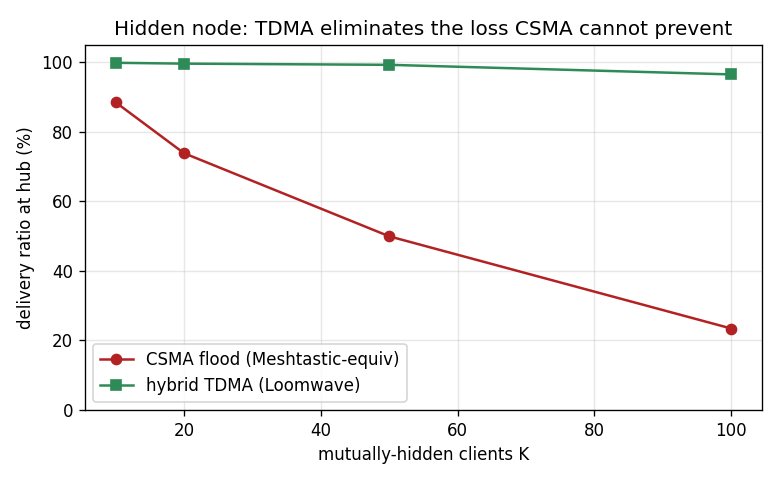

This is the headline Stage-2 result: the measured confirmation of the central design claim —
TDMA eliminates the hidden-node loss that CSMA structurally cannot prevent. It is a relative
comparison on identical topology and traffic, which the validation gate
(north-georgia-validation.md) licensed.
Experiment
The same hidden-node hub as the baseline: K clients all heard by one hub, all mutually hidden from each other, each offering 1 msg/min (LongFast). Only the MAC changes:
- CSMA flood (Meshtastic-equivalent): clients can't sense each other (hidden), so they collide at the hub — ALOHA loss.
- Hybrid TDMA (Loomwave): the hub (INFRA) is the slot authority; each client gets its own slot referenced to the schedule beacon, so transmissions never overlap. Mutual hiding becomes irrelevant — clients never need to hear each other, only the beacon.
Result
| K (hidden clients) | CSMA delivery | TDMA delivery | CSMA loss | TDMA loss | TDMA efficiency |
|---|---|---|---|---|---|
| 10 | 0.885 | 0.998 | 11.5% | 0.2% | 92.5% |
| 20 | 0.738 | 0.996 | 26.2% | 0.4% | 95.8% |
| 50 | 0.499 | 0.992 | 50.1% | 0.8% | 97.9% |
| 100 | 0.234 | 0.965 | 76.6% | 3.5% | 98.6% |
- Collision-free by construction: the hub records
< 5collision decode failures under TDMA at K=50, versus thousands under CSMA — the slots make overlap impossible. - Efficiency ≈ 98–99% at scale, matching the analysis (
mac-layer-options.md§3). It is lower at small K (92.5% at K=10) because the per-frame beacon amortises over fewer slots — an honest overhead the analysis' "amortised beacon" assumption smooths over. - The K=100 TDMA residual (3.5%) is latency, not collision: the frame period (~48 s for 100 LongFast slots) approaches the 60 s message interval, so Poisson bursts occasionally queue. It is a capacity/latency limit (the §3 ceiling), not a reliability failure — and exactly what adaptive modulation + spatial reuse (Q3, task #8) exists to relieve.
- Control overhead is just the beacon (
< 15%of airtime, and falling with K), versus flooding's measured ~90% relay tax — the same lever seen from the MAC side.
Reading
The CSMA curve is the hidden-node problem the project brief names as the central challenge; the TDMA curve is the design answer. The gap widens with K — precisely the regime (an elevated relay gathering many mutually-hidden clients) where the analysis showed CSMA/CAD is helpless. The next results (INFRA-aggregated DV control budget, then adaptive modulation for the capacity ceiling the K=100 residual exposes) build on this same validated comparison.