North Georgia scope-waste study — result
Status: Result. Date: 2026-06-16. Script: sim/experiments/scope_waste.py.
Figure: scope_waste.png. Data: sim/data/malla_ng_calibration.csv (real Malla
per-packet receptions: distance_km, portnum, obs_hops, 19,873 rows, two independent gateway sets).
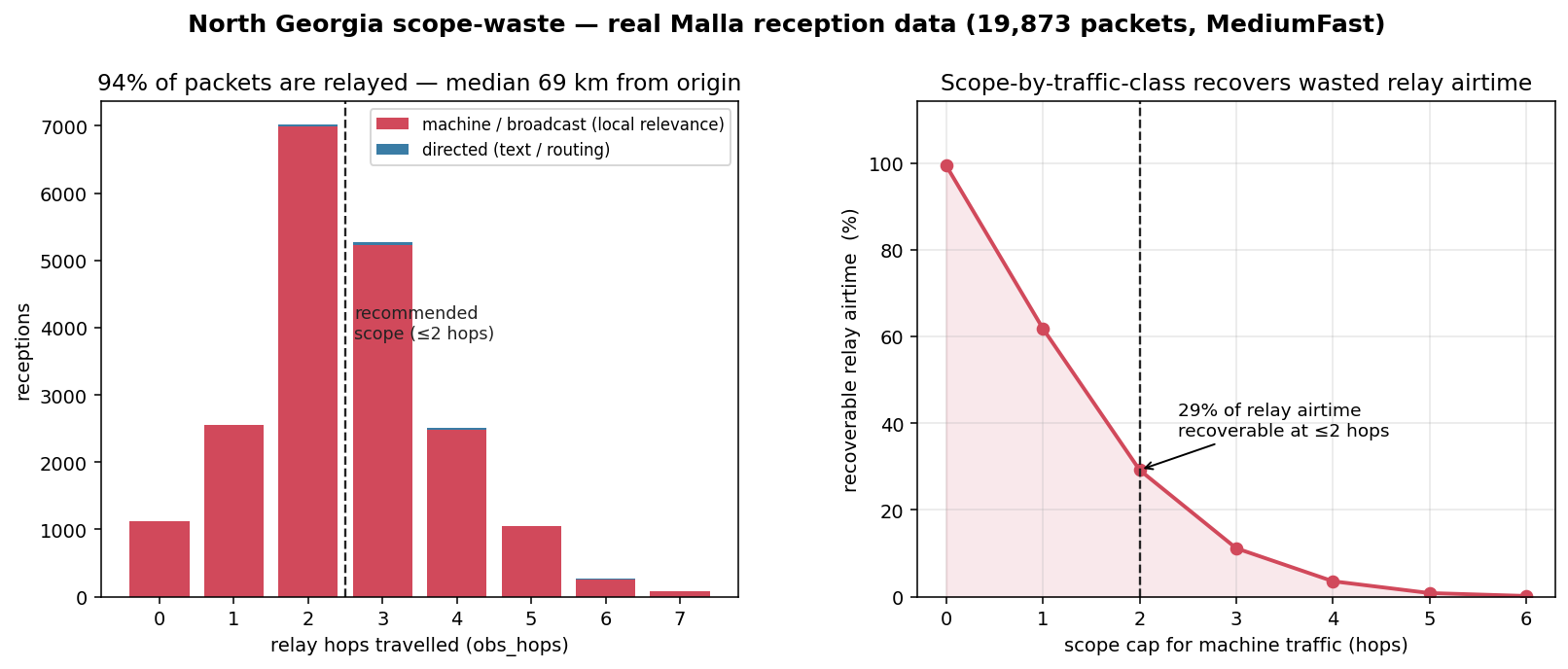
Quantifies, from real data, how far North-Georgia traffic actually propagates vs how far it needs to, and how much relay airtime the over-propagation costs — the empirical case for the data-driven propagation-scope idea (
relevance-scoping-note.md).
Method
For each observed reception we have the straight-line origin→gateway distance, the relay depth
(obs_hops), and the traffic type (portnum). Airtime per packet is time_on_air_ms(size, MediumFast)
using representative PHY payload sizes per type (scenarios/north_georgia.py TYPE_SIZE_B; the CSV
payload_len is decoded-text length and is invalid for airtime, per the calibration caveat). MediumFast
(SF9/BW250) is the channel North Georgia actually runs. Traffic is split into DIRECTED (text, routing —
may legitimately travel) vs machine/broadcast (position, telemetry, nodeinfo, traceroute, unknown —
local relevance; a position beacon has no recipient tens of km away). "Relay airtime" weights each
observed hop by its packet's ToA.
Findings
1. Almost everything is relayed, and it travels absurdly far. - 94.3% of receptions are multi-hop (≥1 relay). Hop distribution peaks at 2–3, tail to 7. - Median origin distance: 69 km. Max: 474 km. For receptions ≥3 hops (46% of all), median 82 km.
2. Almost all of it is machine/broadcast traffic with purely local relevance.
| type | n | % | mean hops | p50 km | p90 km | % >2 hops | class |
|---|---|---|---|---|---|---|---|
| UNKNOWN | 10440 | 52.5 | 2.59 | 81.5 | 164.1 | 48.3 | local |
| POSITION | 3470 | 17.5 | 2.55 | 62.9 | 156.0 | 52.7 | local |
| NODEINFO | 3269 | 16.4 | 2.38 | 69.1 | 114.9 | 34.5 | local |
| TELEMETRY | 1802 | 9.1 | 2.37 | 66.3 | 210.9 | 44.8 | local |
| TRACEROUTE | 769 | 3.9 | 2.09 | 50.7 | 82.2 | 37.2 | local |
| TEXT_MESSAGE | 86 | 0.4 | 2.99 | 118.1 | 205.4 | 69.8 | DIRECTED |
| ROUTING | 28 | 0.1 | 2.39 | 65.1 | 159.2 | 50.0 | DIRECTED |
99.4% of traffic is machine/broadcast; text is 0.4%. Position/telemetry/nodeinfo beacons are being flooded a median ~65–80 km from origin — to nodes that have no use for them.
3. Relaying dominates airtime, and most of it is recoverable by scope. Relaying is ~71% of observed channel airtime (mean ~2.5 hops per packet). Recoverable relay airtime if machine traffic is capped at a per-type scope:
| scope (hops) | recoverable relay airtime |
|---|---|
| ≤1 | 61.8% |
| ≤2 | 29.2% |
| ≤3 | 11.2% |
| ≤4 | 3.6% |
Capping machine/broadcast traffic at ≤2 hops recovers ≈29% of relay airtime ≈ 21% of total channel airtime — by changing one policy field, with text/routing left untouched.

Interpretation
- This is the MeshCore-regions problem measured in real data: traffic routinely floods 5–7 hops and tens-to-hundreds of km past any local relevance, and ~99% of it is machine broadcast that never needed to leave its neighborhood. Regions/hop-limits exist to stop this but go unused for lack of guidance.
- Loomwave structurally avoids most of it: directed messages are coordinator-routed (they don't flood
at all), so this entire waste is the broadcast/discovery flood — exactly what data-driven scope
targets. And the cheapest lever, scope-by-traffic-class (one
TCfield: machine ≤2 hops, text wider), captures a ~21%-of-channel airtime recovery with zero per-operator configuration — the thing manual regions can't deliver. This is the first concrete number for the Level-1 recommendation engine.
Caveats (this is real but imperfect data)
- Reception-weighted, not a TX ledger. One packet heard by K gateways is K rows; the CSV has no packet ID, so we can't dedup. This over-weights widely-flooded packets — but those are the wasteful ones, so it's a defensible proxy for where airtime goes. The hop/distance distributions are exact; the airtime percentages are modeled estimates under this weighting.
- Survivorship bias: gateways log only CRC-decoded, MQTT-uplinked packets, so the farthest/weakest reach is under-counted — the real over-propagation is if anything worse.
- UNKNOWN_APP is encrypted-channel traffic (mostly machine; some could be text), but decoded text is ≤0.5%, so even a generous reassignment doesn't move the conclusion.
distance_kmis straight-line origin→gateway; high-site gateways see a wide footprint.- It's a Meshtastic flood network — which is the point: it's the behavior Loomwave's coordinator routing + scoped broadcast is designed to avoid.
Sim delivery-preserving check (companion)
Script: sim/experiments/scope_delivery_check.py. Figure: docs/figures/scope_delivery_check.png.
Does scoping cost real delivery, or only waste? On the real 47-node NG metro cluster, the validated
flooding model was run at hop_limit ∈ {2,3,4,6} (3 seeds, 1 h each), measuring channel utilisation and
delivery to the within-2-hop audience of each origin (the "relevant" audience, defined on the
mean-path-loss reachability graph) vs. total reach:
| hop_limit | channel util | relevant delivery (≤2 hops) | total reach |
|---|---|---|---|
| 2 | 0.012 | 0.981 | 0.935 |
| 3 | 0.024 | 0.997 | 0.989 |
| 4 | 0.026 | 1.000 | 0.999 |
| 6 | 0.025 | 1.000 | 1.000 |
H=6 → H=2: channel utilisation −54%, total airtime −57%, while within-scope (relevant) delivery only moves 1.000 → 0.981 (−1.9 pts). The reach given up (total 1.000 → 0.935) is the far audience that didn't need the message. So scoping the flood to the relevance radius roughly halves channel airtime and keeps local delivery at ~98% — the saved airtime is almost all redundant relay reach, not useful delivery.

Caveat (this sim's scope): it's one compact cluster (~16×31 km), so it measures intra-cluster redundant-relay reduction. The larger inter-cluster over-propagation the Malla data shows (median 69 km, many clusters) isn't captured here — a multi-cluster run (roadmap S3) would show a bigger cut. This is a conservative lower bound on the airtime scope recovers.
Next steps
- ✅ Delivery-preserving sim check (above) — done; confirms scope cuts airtime without losing relevant delivery.
- Multi-cluster sim (roadmap S3) to capture the inter-cluster waste the single cluster can't.
- Spec scope-by-
TC— machine classes get a tight default hop scope; the highest-leverage, lowest-risk piece ofrelevance-scoping-note.md(needs no reputation system or aggregator). - Feed these numbers into the Level-1 aggregator recommendation design.