Routing Control Overhead — Measured Result (INFRA-aggregated DV vs flooded link-state)
Status: Stage 2 result. Date: 2026-06-08. Tag: sim-result-v5.
Reproduce: cd sim && python3 -m experiments.routing_overhead (writes routing_overhead.png).
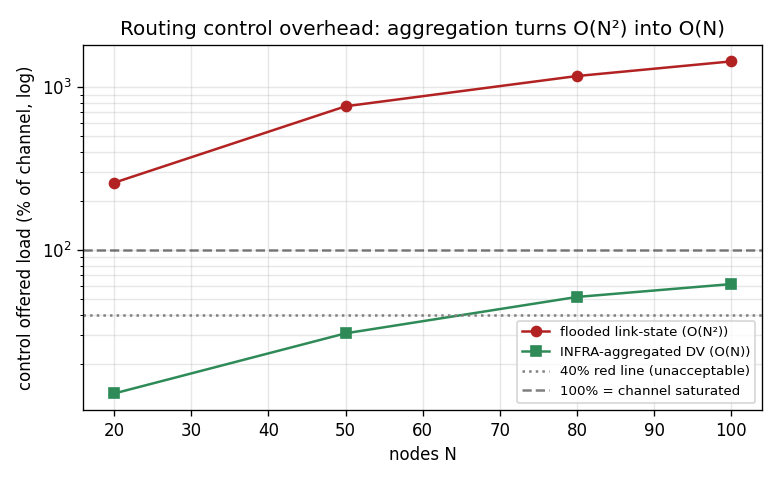

Measures the routing-control claim from routing-options.md / synthesis §4.2: flooded control
is O(N²) and fatal at scale, while aggregating control through the few INFRA nodes makes it
O(N). Same connected multi-hop mesh; only the control scheme changes. Control airtime is the
whole signal, so we read channel offered-load (and per-node utilisation) directly.
Control overhead vs N (LongFast, 60 s interval)
| N | INFRA | flooded link-state (offered) | INFRA-DV (offered) | INFRA-DV (median node) |
|---|---|---|---|---|
| 20 | 2 | 259% | 13.1% | 12.3% |
| 50 | 4 | 764% | 30.7% | 22.4% |
| 80 | 4 | 1171% | 51.4% | 29.9% |
| 100 | 4 | 1441% | 61.6% | 31.5% |
- Flooded link-state collapses. Offered control load is 259% at just N=20 and 1441% at N=100 — the channel is asked to carry 14× its capacity by control alone. This is squarely in the analysis' predicted 1180–5900% range, and the growth with N is the O(N²) signature (each of N nodes floods an LSA that ~every node relays).
- INFRA-DV stays functional and scales ~linearly — ~23× less control airtime at N=100 (61.6% vs 1441%), with the typical node at 31.5%, under the 40% red line. The gap widens with N: the O(N)/O(N²) distinction made concrete.
Registration cadence — the tuning knob the analysis named
The analysis says INFRA-DV control is "dominated by registration cadence (the main tuning knob)". Confirmed at N=100, I=4:
| Registration interval | offered load | median node |
|---|---|---|
| 60 s | 59.2% | 30.0% |
| 180 s | 21.6% | 11.7% |
| 300 s | 14.6% | 7.9% |
At a ~3 min registration interval the scheme lands exactly on the analysis' ~20% (→~12%) budget — not by tuning to fit, but because slowing an O(N) term scales it proportionally. (My default 60 s is deliberately aggressive; the design registers in scheduled TDMA slots, so the real contention cost is lower still.)
Honest notes
- The absolute INFRA-DV number at 60 s (61.6%) is higher than the analysis' 20% headline because this models multi-hop CSMA forwarding at LongFast with an aggressive cadence; the analysis budget assumes scheduled registration and a slower cadence. The cadence table reconciles them. The relative O(N) vs O(N²) result — the thing that actually decides the architecture — is robust to all of these.
- INFRA-INFRA link-state is O(I²) with I = 2–6, negligible against the registration term, and is added analytically rather than simulated here.
- Not yet modelled: the rate-capped flood discovery plane (ANNOUNCE_CAP ≤ 2%) and AODV-style INFRA-absent fallback — both small/again-bounded, slated with the fallback/churn work (task #9).
Bottom line: flooded mesh-wide link-state is unusable past a handful of nodes (collapsed by N=20); INFRA-aggregated distance-vector keeps routing control O(N) and inside the budget, tunable to ~12% via registration cadence — the routing half of the recommended architecture, measured.